Life Cycle of Ticks: Hard and Soft Ticks, Larval, Nymphal and Adult Stages
The life cycle of ticks consists of several developmental stages, with important differences between hard and soft ticks. Understanding these stages, including the larval, nymphal, and adult phases, as well as one-, two-, and three-host life cycles, is essential for understanding tick biology and their veterinary importance.
All ticks are parasitic during some stages of their life cycle. Soft ticks are found in cracks and crevices and behave like bugs. They engorge within 30 minutes and fall off. Both male and female soft ticks engorge. Adult hard ticks are found on the bodies of animals. Male hard ticks cannot engorge extensively and feed at intervals, whereas females engorge continuously for about one week. Female hard ticks engorge only once in their lifetime and then fall off.
General Life Cycle
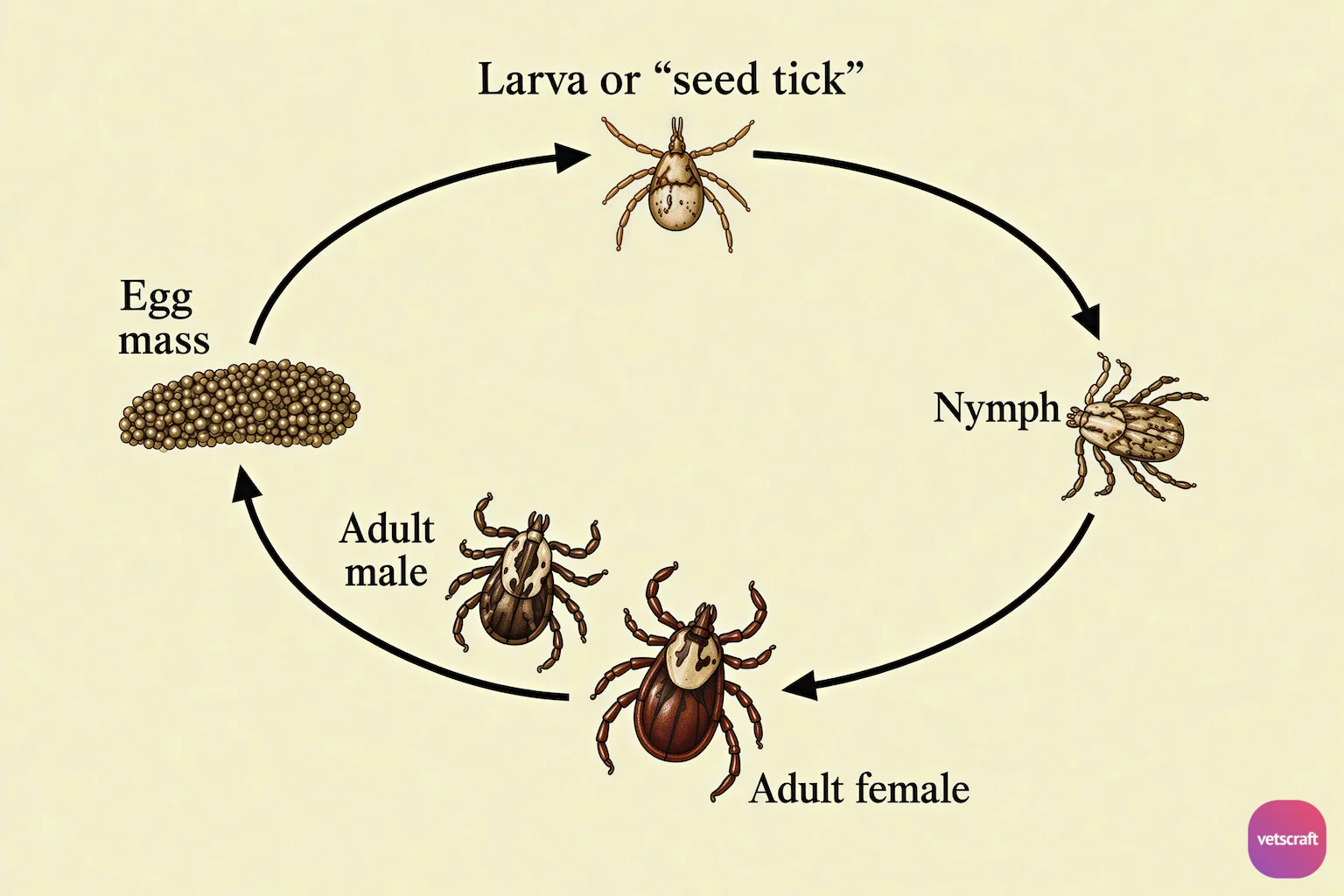
Both male and female ticks come into apposition on the ventral aspect during copulation. Males dilate the genital opening of the female with their mouthparts. Sperm is introduced into the female as balls called spermatophores. After engorgement, female hard ticks fall off and lay eggs (about 18,000) and die. Male ticks die on the body of the animal in about 4 months.
Female soft ticks lay eggs (20–100) after each engorgement during intermittent feeding. However, the total number of eggs laid by a female soft tick is lower than that of hard ticks.
Larval and Nymphal Stages
After about 3 weeks, the eggs hatch and the larvae emerge. The larva of hard ticks is known as a “seed tick” or “pepper tick.” The larvae have 3 pairs of legs, and mouthparts are seen on the anterior aspect (dorsally). Haller’s organ is present. Spiracles and the genital opening are absent. The scutum is confined to the anterior third of the body. Larvae are found on the ground and can resist starvation for several months. Seed ticks attach to grass and wait for the host (questing larval stage). They attach to animals as they pass by and begin to engorge. They feed for about one week, fall off, and become nymphs in about 2–3 weeks. In soft ticks, larvae have mouthparts on the anterior aspect.
Nymphs have four pairs of legs. Stigmal openings are present. The genital orifice and porose area are absent. In hard ticks, one nymphal stage is present, whereas in soft ticks, two or more nymphal stages are present. The scutum is restricted to the anterior part of the body. Mouthparts of soft ticks are not visible on the dorsal aspect. After engorgement, the nymph falls off and molts to become an adult.
The life cycle is completed within two months in hard ticks and about 8 months in soft ticks. Hard ticks cannot survive prolonged starvation, whereas soft ticks can survive for up to 6 years. Nymphs of soft ticks behave like adults.
Classification of Hard Ticks
Hard ticks are classified according to the number of hosts they require to complete their life cycle.
One-Host Tick
In a one-host tick, all three stages are found on the same animal, where they feed and molt. Such a tick is known as a one-host tick.
All molting takes place on the host itself. Example: Boophilus microplus.
Two-Host Tick
In a two-host tick, the larva attaches to one animal, engorges, and molts to become a nymph. The nymph also engorges and drops off the first host. The engorged nymph molts to become an adult.
The adult attaches to a second host. The adult also engorges and drops off the second host for egg laying. The first molt occurs on the host, and the second occurs on the ground. Example: Hyalomma marginatum.
Three-Host Tick
A three-host tick requires 3 different hosts for the completion of its life cycle. The larva attaches to the first host, engorges, and falls off. On the ground, it molts to become a nymph. The nymph attaches to the second host, engorges, and falls off. On the ground, it molts to become an adult.
The adult attaches to the third host, engorges, and falls off for egg laying. All molting takes place outside the host. Example: Rhipicephalus sanguineus.