TABLE OF CONTENTS
Melophagus ovinus (Sheep Ked): Morphology, Life Cycle, Pathogenicity & Control
Melophagus ovinus, commonly known as the sheep ked, sheep tick fly, or wingless fly, is a wingless, hairy, leathery fly that is brown in color. It belongs to the family Hippoboscidae and is a permanent blood-feeding ectoparasite that primarily infests sheep and occasionally goats, spending its entire life on the host.
Sheep keds cause irritation, blood loss, wool damage, and reduced hide quality, resulting in significant economic losses in sheep farming. This article covers the morphology, life cycle, pathogenicity, and control of Melophagus ovinus.
NOTE
Despite being commonly called the sheep tick, Melophagus ovinus is not a tick. It is a wingless, blood-feeding fly belonging to the family Hippoboscidae (order Diptera). Unlike true ticks, sheep keds are insects with three pairs of legs and spend their entire life cycle on the host.
Morphology
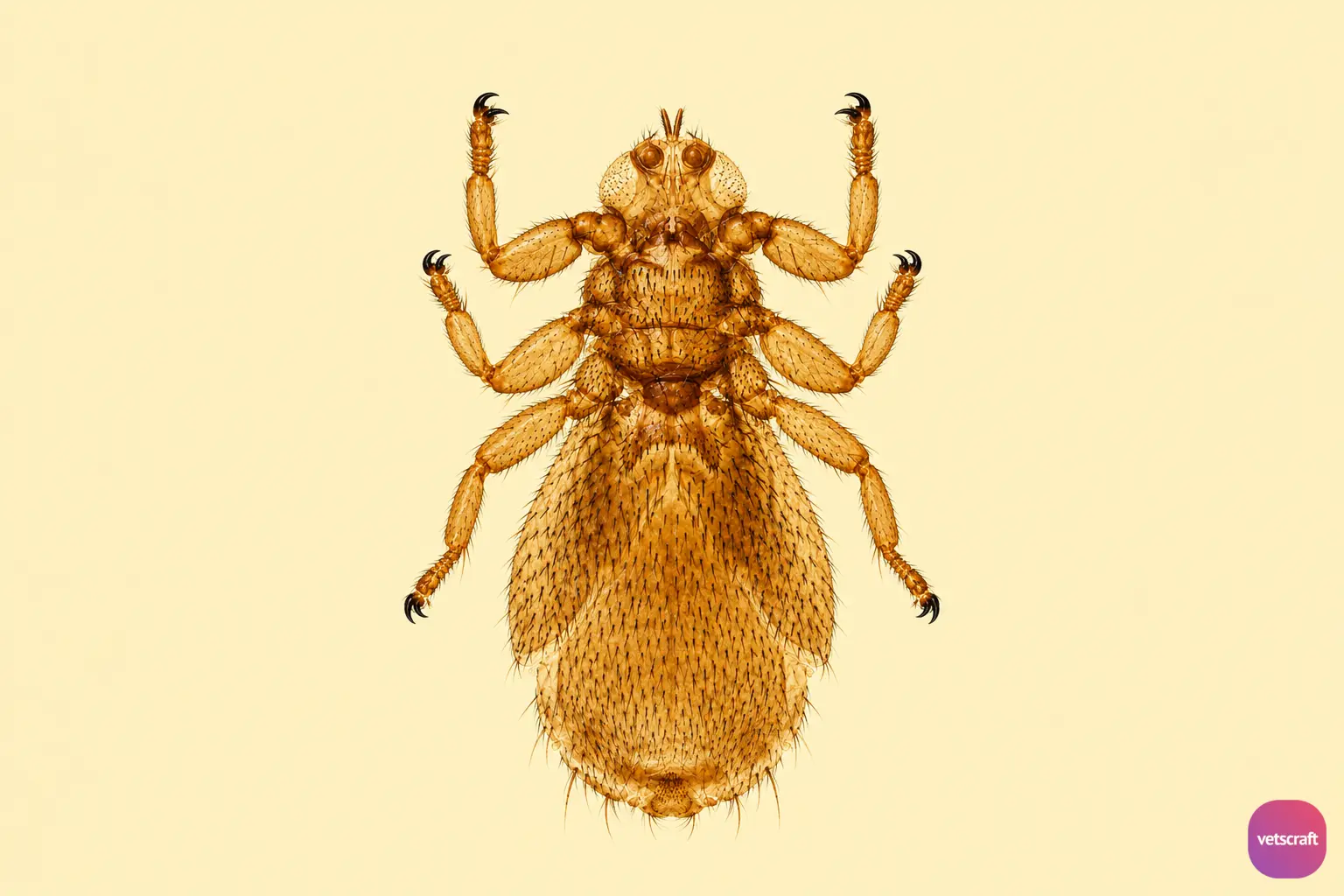
- Melophagus ovinus (sheep ked) is a wingless, hairy, leathery fly that is brown in color.
- Single-segmented antennae.
- The proboscis is located centrally. The mouthparts consist of maxillary palps, a bulbous labium, a stylet-like labrum, and a needle-like hypopharynx.
- Sac-like abdomen.
- Three pairs of legs, with the terminal segment of each leg ending in powerful claws.
- Hairs are present all over the body. Two pairs of spiracular openings are present on the thoracic segment, while additional spiracles are present on the terminal abdominal segments.
Life Cycle
Melophagus ovinus (sheep ked) is a permanent ectoparasite. The fly is transmitted from one sheep to another through direct contact.
The female is larviparous. The larva remains inside the uterus for 10–12 days, after which the female deposits a single mature L₃ larva on the sheep’s wool using a sticky secretion.
The larva is immobile and quickly turns into a chestnut-brown pupa. The pupa is ovoid in shape and lasts for 21–30 days.
Copulation occurs 3–4 days after adult emergence, and each gestation lasts about 10–12 days. The female lives for about 5 months and can produce 10–15 L₃ larvae during her lifetime.
Pathogenicity
Melophagus ovinus occurs widely in sheep and goats in temperate regions of the world, especially in hilly areas. They live in the wool of sheep, lead a parasitic life, and suck large quantities of blood. Heavy infestations can cause anemia.
It produces intense irritation, causing sheep to scratch, bite, and pull out their wool. When wool is swallowed by the sheep, hairballs may form in the stomach.
The feces of the sheep ked permanently stain the wool and cannot be washed out easily. As a result, the value of the wool is reduced. It acts as a cyclical vector of Trypanosoma melophagium.
The damage caused by the parasite to sheep hide is known as “Cockle,” which is characterized by vertical ridging of the skin. The bites of sheep keds produce pimple-like blemishes on the skin.
Control
- Shear the wool during summer.
- Spray chlorinated hydrocarbons.
- Spray organophosphates such as ronnel 24% (in 4.5 L of water), diazinon 0.06%, or ciodrin 1%, which are effective against sheep keds. Tip spraying is an effective control measure for short-fleeced sheep, but a second treatment may be necessary for long-wool breeds. Malathion and Sumithion 0.5% solutions can also be applied to the body of sheep.