TABLE OF CONTENTS
Hippobosca maculata (Forest Fly): Morphology, Life Cycle, Pathogenesis & Control
Hippobosca maculata (forest fly) belongs to the Series Pupipara and the family Hippoboscidae. It is commonly known as the winged fly, forest fly, and louse fly. It is a blood-feeding ectoparasite of livestock, primarily affecting cattle and horses, where it causes irritation, blood loss, and reduced productivity.
The fly is highly adapted to a parasitic lifestyle and is of veterinary importance because it serves as a biological vector of Trypanosoma theileri in cattle. Understanding its morphology, life cycle, pathogenic effects, and control measures is essential for the effective management of infestations in domestic animals.
Series Pupipara
- Members of the Series Pupipara are markedly adapted for parasitic life.
- The body is broad and dorsoventrally flattened.
- The antennae are single-segmented and lie in pits on the forehead.
- The wings may or may not be present.
- Three pairs of legs are provided with strong claws.
- The abdomen is indistinctly segmented, soft, and leathery.
- As the name implies, these flies lay or deposit fully mature L₃ larvae that are ready to pupate.
Morphology
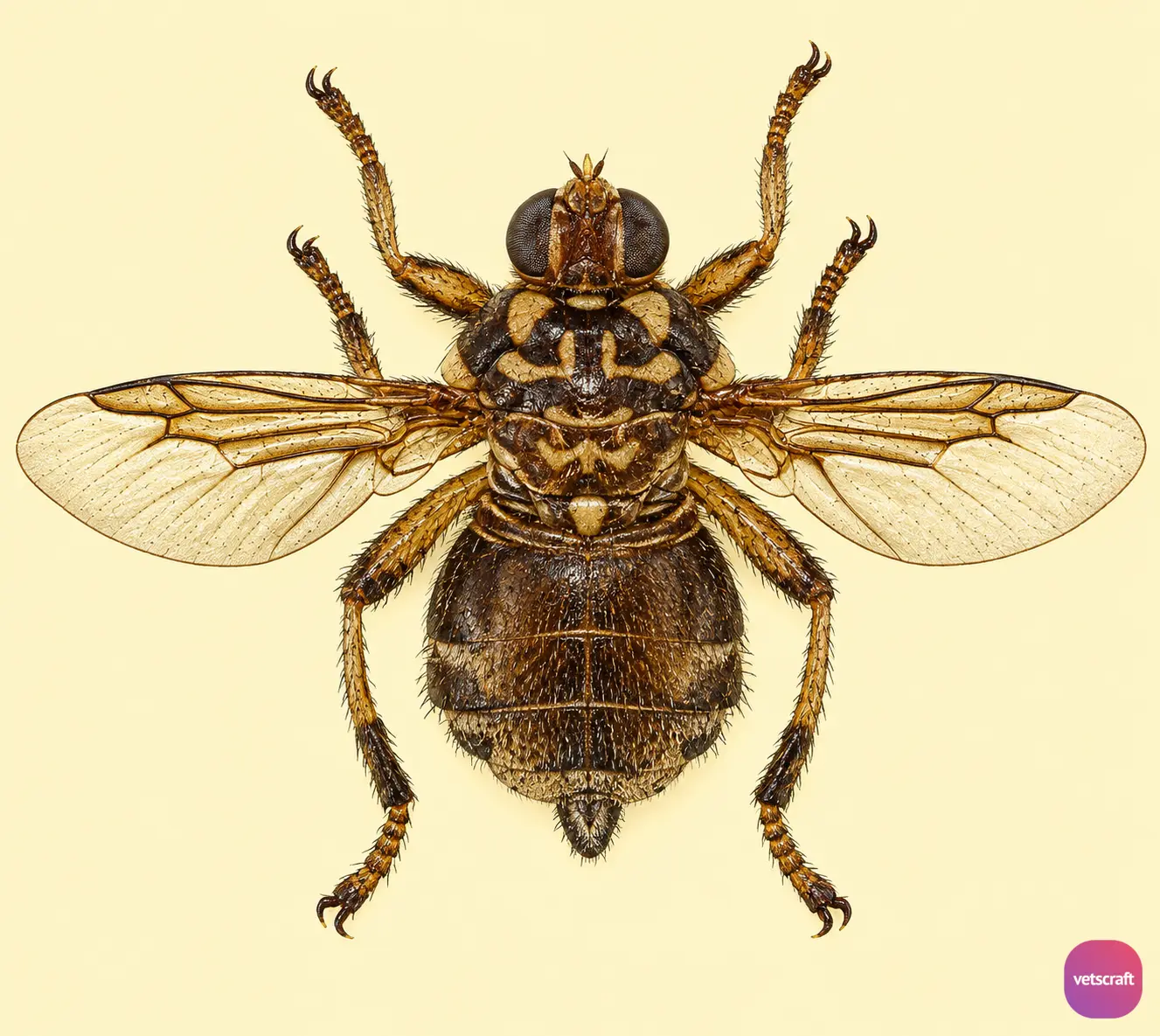
- Hippobosca maculata (forest fly) has a dorsoventrally flattened body. The fly has yellowish spots on the thorax and abdomen. The abdomen is sac-like.
- Has a pair of compound eyes.
- The labella are formed with prestomal teeth.
- The hypopharynx and labrum-epipharynx are located in the labial gutter.
- The longitudinal veins are crowded in the anterior region of the wing, and the posterior region is membranous with fan-like folds.
- The abdomen is indistinctly segmented, soft, and leathery.
- They have short, broad legs armed with powerful claws.
- The exoskeleton of this fly is soft and leathery. When crushed, the fly is not easily killed.
- It is very well adapted for parasitic life.
Life Cycle
Hippobosca maculata (forest fly) is a pupiparous fly. The female deposits one 3rd-stage larva at a time in sheltered locations in and around animal shelters.
When the L₃ larva is deposited, it is whitish in color, oval in shape, and possesses a dark spot at the posterior pole. Within a few minutes, the yellow larva turns into a brown pupa. The pupal period lasts for 20–25 days.
Pathogenesis
Hippobosca maculata (forest fly) is seen in large numbers during summer in horses and cattle. The fly is a temporary parasite and remains on the host for extended periods. They are not inclined to travel more than a few meters, although they are strong fliers. They cluster around the neck region of the animal.
The preferred feeding sites are the perineum and the area between the hind legs. They cause irritation, suck blood, and can cause severe anemia. They act as a cyclical vector of Trypanosoma theileri in cattle.
Control
Spray the animal’s body with an oil-based insecticide containing pyrethrins or with 1% Ciodrin plus 0.2% DDVP, Malathion, or a 0.5% Sumithion solution.