Ovine and Bovine Fasciolosis: Pathogenesis, Clinical Signs, Diagnosis, Treatment & Control
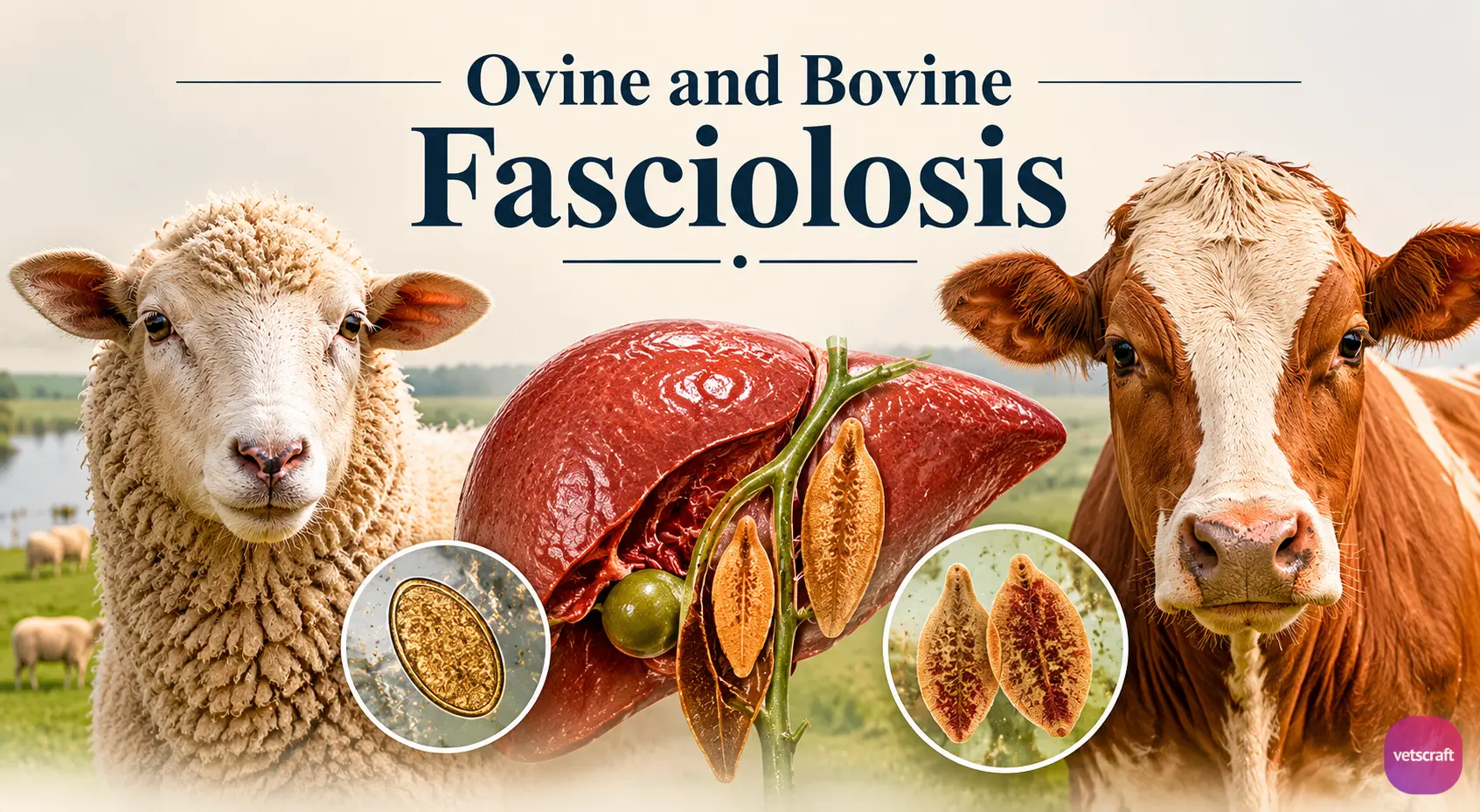
Fasciolosis is a parasitic disease caused primarily by Fasciola hepatica and Fasciola gigantica. It affects sheep, cattle, and other ruminants worldwide, causing liver damage, reduced productivity, weight loss, and economic losses. The disease may occur in acute, subacute, or chronic forms depending on the number of metacercariae ingested and the stage of infection.
The two most important species are Fasciola hepatica (the common liver fluke) and Fasciola gigantica (the giant liver fluke). F. hepatica is predominantly found in temperate regions, whereas F. gigantica occurs mainly in tropical and subtropical areas. Adult flukes inhabit the bile ducts of the liver, where they cause tissue damage, inflammation, fibrosis, and significant economic losses due to reduced productivity, poor weight gain, and decreased milk production.
Ovine Fasciolosis
The pathogenesis of ovine fasciolosis may be divided into three types:
- Acute Fasciolosis
- Subacute Fasciolosis
- Chronic Fasciolosis
1. Acute Fasciolosis
Acute fasciolosis is less common than the chronic form but is typically observed in sheep. It occurs approximately 2–6 weeks after the ingestion of a large number of metacercariae (2,000–10,000).
Traumatic hepatitis develops due to the migration of large numbers of immature flukes through the liver parenchyma, causing extensive tissue destruction and marked hemorrhage.
When the fluke burden is high, rupture of the liver capsule may occur, resulting in the accumulation of hemorrhagic or blood-stained fluid within the peritoneal cavity.
At necropsy, the liver is enlarged, hemorrhagic, and contains honeycomb-like migratory tracts with immature flukes.
The ventral lobe is covered with fibrinous exudate. Small flukes can be squeezed from the cut surface of the liver or recovered from excess peritoneal fluid.
Complication of Acute Fasciolosis
A major complication of acute fasciolosis is “Black Disease,” caused by Clostridium novyi (formerly Clostridium oedematiens), an anaerobic bacterium that proliferates within the anaerobic necrotic lesions produced by immature flukes. Although the organism may be present in a normal liver, clinical disease develops only after liver damage caused by migrating flukes.
2. Subacute Fasciolosis
Subacute fasciolosis occurs approximately 6–10 weeks after the ingestion of 500–10,000 metacercariae over a prolonged period.
Some flukes may reach the bile ducts and cause cholangitis, while others continue migrating through the liver, producing migratory tracts that induce infiltration of inflammatory cells and early fibrosis.
The subacute form may be superimposed on an existing chronic infection. Death usually occurs 1–2 weeks after the onset of clinical signs.
Clinical signs include loss of body condition, pale mucous membranes, hepatitis, submandibular edema (bottle jaw), ascites, and abdominal pain on palpation.
3. Chronic Fasciolosis
Chronic fasciolosis is the most common form of the disease and occurs approximately 4–6 months after ingestion of a moderate number (200–500) of metacercariae over a prolonged period.
The principal pathogenic effects are anemia and hypoalbuminemia. More than 0.5 mL of blood per fluke may be lost into the bile ducts each day.
Loss of plasma proteins occurs due to leakage of albumin through the hyperplastic biliary mucosa, resulting in submandibular or facial edema commonly known as “bottle jaw.”
At necropsy, the liver has an irregular outline and appears pale and firm. The ventral lobe is severely affected and reduced in size. Liver pathology is characterized by fibrosis and hyperplastic cholangitis.
Types of Hepatic Fibrosis
- Post-necrotic Scarring: Associated with healing of migratory tracts. It occurs primarily in the ventral lobe. Contraction of scar tissue may result in distortion of hepatic architecture.
- Ischemic Fibrosis: Caused by obstruction of blood flow due to damage and thrombus formation within the hepatic veins.
- Peribiliary Fibrosis: Occurs when flukes reach the smaller bile ducts.
- Monolobular Fibrosis: Occurs approximately 12–20 weeks after infection. This type of fibrosis assists in restoring normal hepatic architecture.
- Perisinusoidal Fibrosis: Caused by increased hepatic blood pressure resulting from partial or complete occlusion of secondary and tertiary portal veins due to edema of surrounding tissues. Hepatic arteries may also become thickened and tortuous.
Hyperplastic Cholangitis
Hyperplastic cholangitis is caused by severe erosion and necrosis of the biliary mucosa due to feeding activity of adult flukes. Hyperplasia of the bile duct epithelium, along with infiltration of eosinophils and mononuclear cells, leads to fibrosis. Fluke eggs may also induce granulomatous reactions within smaller bile ducts.
Bovine Fasciolosis
Acute and subacute fasciolosis are very rare in cattle, whereas the chronic form is common in adult animals. The pathogenesis is similar to that in sheep, except that calcification of fibrotic lesions and calcium deposition may result in obstruction of the bile ducts. The calcified bile duct walls protrude markedly from the liver surface and are difficult to cut with a knife. These protruding ducts resemble the stem of a clay pipe, giving rise to the terms “Clay-Pipe Cirrhosis” and “Pipe-Stem Liver.”
Ectopic migration of flukes is relatively common in cattle. Flukes may be found in the lungs, where they produce peanut-sized nodules. Prenatal infection has also been reported, and immature flukes may occasionally be found in the fetus.
Clinical Signs of Fasciolosis
Sheep (Ovine Fasciolosis)
In acute cases, animals may die suddenly and may exhibit bloody discharge from the anus, resembling anthrax, as well as blood-stained froth from the nostrils.
In chronic cases, clinical signs include anemia, lethargy, reduced appetite, pale mucous membranes, edema of the intermandibular region (bottle jaw), dry and doughy skin, debility, and emaciation. Constipation and diarrhea may occur intermittently. The wool becomes dry, brittle, and may fall out in patches.
Cattle (Bovine Fasciolosis)
The primary clinical sign in cattle is digestive disturbance. Constipation is common, and feces are often hard and dry. Diarrhea may occur in severe cases. Emaciation and weakness can progress to prostration, particularly in calves. Milk production is reduced.
Epidemiology
Summer Infection of Snails
During wet summers, snail populations multiply rapidly and become infected by miracidia hatching from eggs between May and July. If wet conditions persist, snails shed large numbers of cercariae onto pastures from July through October. Conversely, if the climate during May–July is dry or cold, fewer snails are present, fewer fluke eggs hatch, and autumn pasture contamination is substantially reduced. Clinical fasciolosis resulting from summer infection of snails usually arises from the ingestion of large numbers of metacercariae over a short period between July and October.
| Disease Type and Peak Incidence | Clinical Signs | Fluke Numbers | FEC (epg) | Treatment |
|---|---|---|---|---|
| Acute – July to December | Sudden death or dullness, anaemia, dyspnoea, ascites, and abdominal pain. | 1000+ mainly immature | 0 | Triclabendazole. Treat all sheep and move to a lower-risk (drier) pasture if possible, or re-treat after 3 weeks. |
| Subacute – October to January | Rapid weight loss, anaemia, submandibular oedema, and ascites in some cases. | 500–1000 adults and immature flukes | <100 | Treat with a fasciolicide active against mature and immature flukes. If sheep cannot be moved to a lower-risk pasture, re-treat after 5–8 weeks. |
| Chronic – January to April | Progressive weight loss, anaemia, submandibular oedema, diarrhoea, and ascites. | 200+ adults | 100+ | All fasciolicides are active against the mature flukes involved in chronic disease. Treat and move to a lower-risk pasture. |
Diagnosis of Fasciolosis
Diagnosis is based on clinical signs, fecal examination for fluke eggs, and postmortem findings:
- Hematological Tests: Estimation of PCV, albumin, and liver enzymes such as glutamate dehydrogenase (GLDH) and gamma-glutamyl transferase (GGT). Levels of these enzymes are typically elevated in fasciolosis.
- Immunological Tests: ELISA and passive hemagglutination tests may be used to detect antibodies against Fasciola. Coproantigen ELISA can also be employed to detect parasite antigens in feces.
Treatment
Old Drugs
- Carbon Tetrachloride (CCl₄)
- Cattle: Not used
- Sheep: 1 mL by I/M route; during outbreaks, up to 5 mL
- Hexachlorethane
- Cattle: 220 mg/kg body weight, 3–4 doses
- Sheep: 20–30 g/animal (adult)
- Hexachlorophene
- Cattle: 10–20 mg/kg body weight
- Sheep: 15 mg/kg body weight (oral or S/C)
- Hetol
- Cattle: 125 mg/kg body weight (oral)
- Sheep: 150 mg/kg body weight
- Bithionol
- Cattle: 30–35 mg/kg body weight
- Sheep: 40 mg/kg body weight (oral)
- Nitroxynil
- Cattle: Not used
- Sheep: 10 mg/kg body weight (S/C)
New Drugs
- Oxyclozanide
- Cattle: 15–20 mg/kg body weight
- Sheep: 10–15 mg/kg body weight (oral)
Control of Fasciolosis
- Control of the snail intermediate host (I/H).
- Control of reservoir hosts (R/H), including deer.
- Treat infected animals with anthelmintics at least twice a year: the first treatment during summer (April) against immature flukes and the second during winter (October/November) against mature flukes.