Snail Control Methods for Prevention of Trematode Infections: Molluscicides, Biological Control, and Management Practices
Snail control is an important component of trematode (fluke) disease prevention in both veterinary and public health. Many trematodes require snails as intermediate hosts to complete their life cycle. Therefore, reducing or eliminating snail populations helps interrupt parasite transmission and prevents environmental contamination with infective stages such as cercariae and metacercariae.
Various mechanical, chemical, biological, and management-based methods are used to control snails and reduce the incidence of trematode infections in animals and humans.
Importance of Snail Control
Snails act as intermediate hosts for trematodes; therefore, snail control is important in preventing trematodosis. Snails belong to the phylum Mollusca. The study of snails is called malacology.
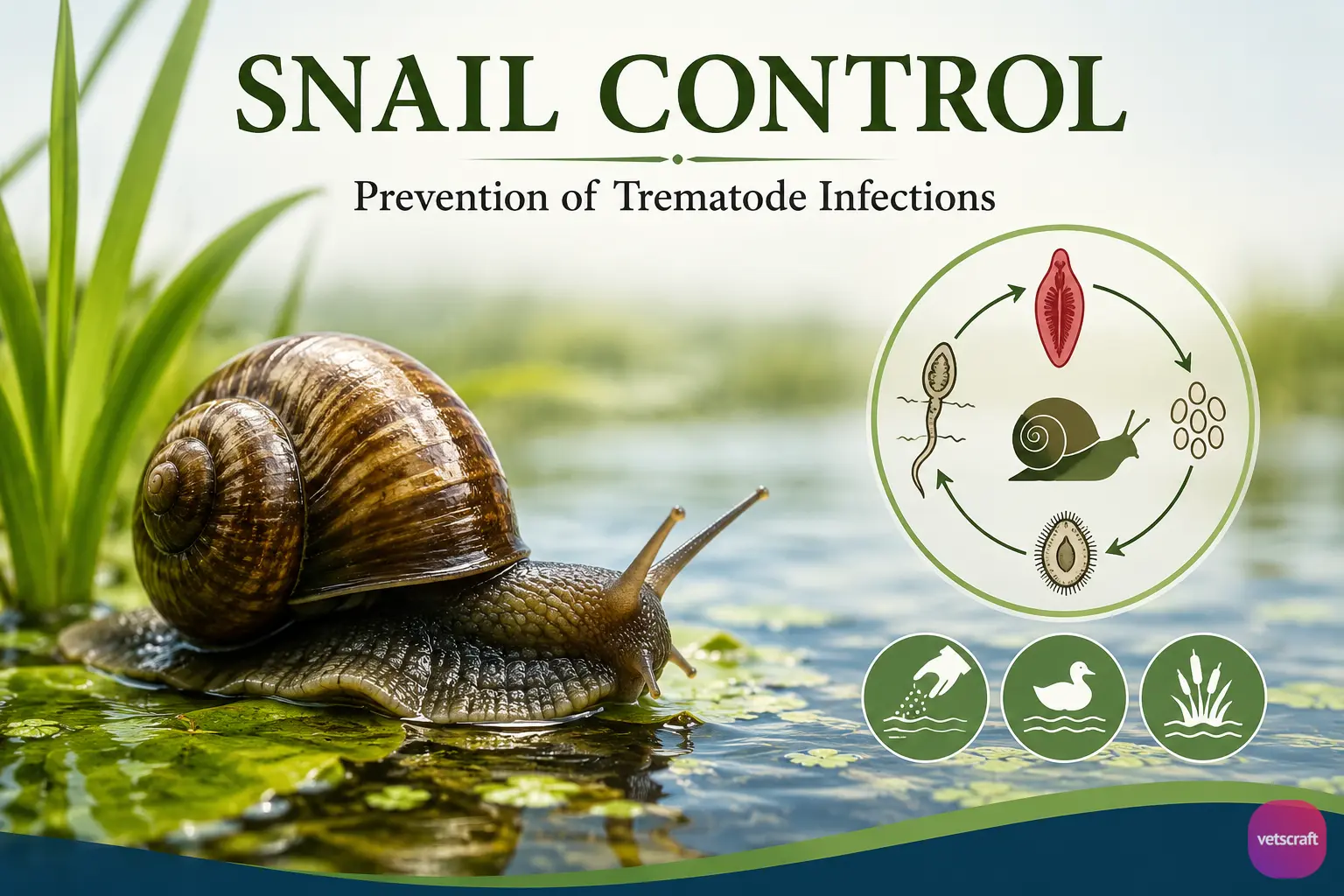
The Mollusca (common name molluscs or mollusks; derived from the Latin Molluscus, from mollis, meaning “soft”) is a large phylum of invertebrate animals. There are around 85,000 recognized species of mollusks. Mollusca is the largest marine phylum, comprising about 23% of all named marine organisms.
Types of Snails
- Land Snails: Macrochlamys cassida, Zebrina detrita, Cionella lubrica
- Aquatic Snails: Lymnaea tomentosa, L. auricularia, L. rufescens, L. acuminata, Indoplanorbis exustus, and Gyraulus convexiculus
Methods of Snail Control
Elimination of snails can be undertaken by:
- Mechanical or Physical Methods
- Chemical Methods (Molluscicides)
- Biological Methods (Biocontrol)
- Control of Snails by Management Practices
1. Mechanical or Physical Methods
Physical methods have been employed successfully in many areas. In the case of aquatic snails, elimination of breeding sites and direct elimination of snails are the two main approaches.
Elimination of breeding sites can be achieved by draining marshy areas or by removing aquatic vegetation mechanically or through the use of herbicides such as Agroxone.
Various mechanical or physical methods of snail population control include:
- Hand-picking and crushing
- Using nets and screens
- Drainage
- Collecting snails using palm or coconut leaves
- Clearing vegetation
2. Chemical Methods (Molluscicides)
Certain chemical methods have been used for snail control. These chemicals are generally categorized as attractants, contact poisons, or repellents. Care must be taken in the use and handling of these chemicals because some may be toxic to humans and animals and harmful to certain plants.
- Copper Sulfate at 10 ppm: For running water, CuSO₄ bags can be placed at one end of the stream (effective up to 1.5 km). In ponds, CuSO₄ bags can be dragged along the edges. One part CuSO₄ mixed with four parts sand can be broadcast over pastures. Copper sulfate at 22.5 kg/ha as a 0.5% solution has been recommended. However, it may kill edible fish.
- Copper Sulfate at 1 Part in 5 Million: In marshy areas, copper sulfate should be mixed with four to eight parts sand, whereas in pastureland, a 1–2% solution can be used. Copper sulfate solutions ranging from 1 in 100,000 to 1 in 5 million are effective and can also be used as a powder with a sand carrier at a rate of 10–35 kg/hectare.
- Copper Pentachlorophenate: Copper pentachlorophenate is considerably more effective as a molluscicide than copper sulfate when applied at a rate of 11.2 kg/ha in a high-volume spray of 4,500 L/ha.
- Other chemicals include copper carbonate, calcium cyanamide, common salt, benzene hexachloride, mercury compounds (phenylmercuric salts), quaternary ammonium compounds (QACs), potassium aluminum sulfate, several arsenical compounds, and metaldehyde (Meta Fuel), which is used to control land snails and slugs. Metaldehyde baits are often mixed with calcium arsenate or sodium fluosilicate.
- Sodium pentachlorophenate (Santoborite) at 10 ppm
- Baylucide at 0.5–1 ppm
- Frescon Tritilomorphilin at 0.45 kg in 680 liters per hectare can be used as a spray, with two applications per year.
- Aqualin (acrolein, Shell Chemical) at 3 ppm
- A bait consisting of calcium arsenate (bran 25 lb, calcium arsenate 2 lb, molasses ¾ gallon, and water 1 gallon) is highly effective against land snails.
- Sodium arsenite (“Penite,” a 40% commercial solution) has been used as a spray in the form of a 0.5–1.0% solution. However, it is expensive and harmful to vegetation.
3. Biological Methods (Biocontrol)
Several biological agents, including algae, bacteria, flies, fungi, nematodes, plants, competitors, predators, and parasites, can adversely affect the reproduction and/or growth of snails. Attempts have therefore been made to apply this concept in the biocontrol of snail vectors of trematodes.
Plants
Some plants possess molluscicidal properties. Planting these trees and shrubs along streams and irrigation channels can help reduce snail populations.
- Fruits of Balanites aegyptiaca (Nanjundan; Garapandu)
- Acacia concinna
- Sapindus emarginatus (soapberry, Pongan Kottai, Kunkudu Kayalu; soapnut, Shikakai)
- Caesalpinia coriaria (Divi-divi, Inki Maram)
- Mahua (Madhuca indica) seed cake extract is used to kill Indoplanorbis exustus.
- Neem (Azadirachta indica), papaya (Carica papaya), and eucalyptus leaf extracts (Eucalyptus globulus) have molluscicidal effects against I. exustus and Lymnaea luteola.
Animals
- Rearing fish such as gourami (Ospheromenus gourami) and guppies (Poecilia reticulata; Lebistes reticulatus), which consume snail eggs.
- Introducing ducks into ponds, lakes, and rice fields, as they feed on snails.
- Firefly larvae, which feed on snail eggs.
- Larvae of the flesh fly (Sarcophaga misera) are predators of I. exustus.
- Larvae of the insect fly Lamprophorus tenebrosus.
- Ostracod (Cypridopsis hartwigi).
- Larvae and adults of the sciomyzid fly Sepedon macroplus.
- Dechaetophora hendeli and D. biroi have been reported to be efficient snail predators.
- Sciomyzidae larvae, particularly Sepedon senex, prey on snail vectors such as I. exustus, L. auricularia, and G. convexiusculus.
- Large leeches.
- The water bug Sphaerodema annulatum has been found to attack L. acuminata.
- Introduction of predatory snails (Marisa cornuarietis, Zonitoides nitidus, Oxychilus draparnaudi, and Physa fontalis) has been found to control L. truncatula populations in pastures.
4. Control of Snails by Management Practices
- All infested paddocks, marshy and low-lying areas, and areas surrounding water sources should be closed to grazing by fencing or other means. Herbage from such areas should be converted into hay or silage before use.
- Remove manure promptly.
- Provide clean drinking water in troughs. If water from a questionable source must be used, shallow creeks or bays separated from the main body of water can be constructed and treated with molluscicides. Regular removal of vegetation from drainage channels will help prevent the development of snail habitats. Proper watering facilities should be established to prevent animals from drinking from lakes, ponds, and streams.
- In rice-growing areas, the use of raw manure as fertilizer results in heavy infections in snails. This practice should be discontinued, and farmers should be educated to use compost instead of raw manure.
- Because snails commonly shelter under foliage near water, cleaning the banks of streams and reservoirs is an important control measure.
- Cattle are more inclined to graze in marshy areas than sheep and may serve as a source of infection for sheep grazing on the same pasture.
- Separation of cattle and sheep, especially during warm periods when snail infestations are more likely, is highly desirable.
- Other methods include filling small pools and pits with sand and filtering water in irrigation channels using reed mats, palm leaves, or similar materials to trap snails and their eggs.