Mode of Transmission of Parasites
The mode of transmission of parasites refers to the various ways through which parasites enter and infect the host. Parasites may reach the host either actively by their own movement or passively through food, water, contact, milk, placenta, or other routes.
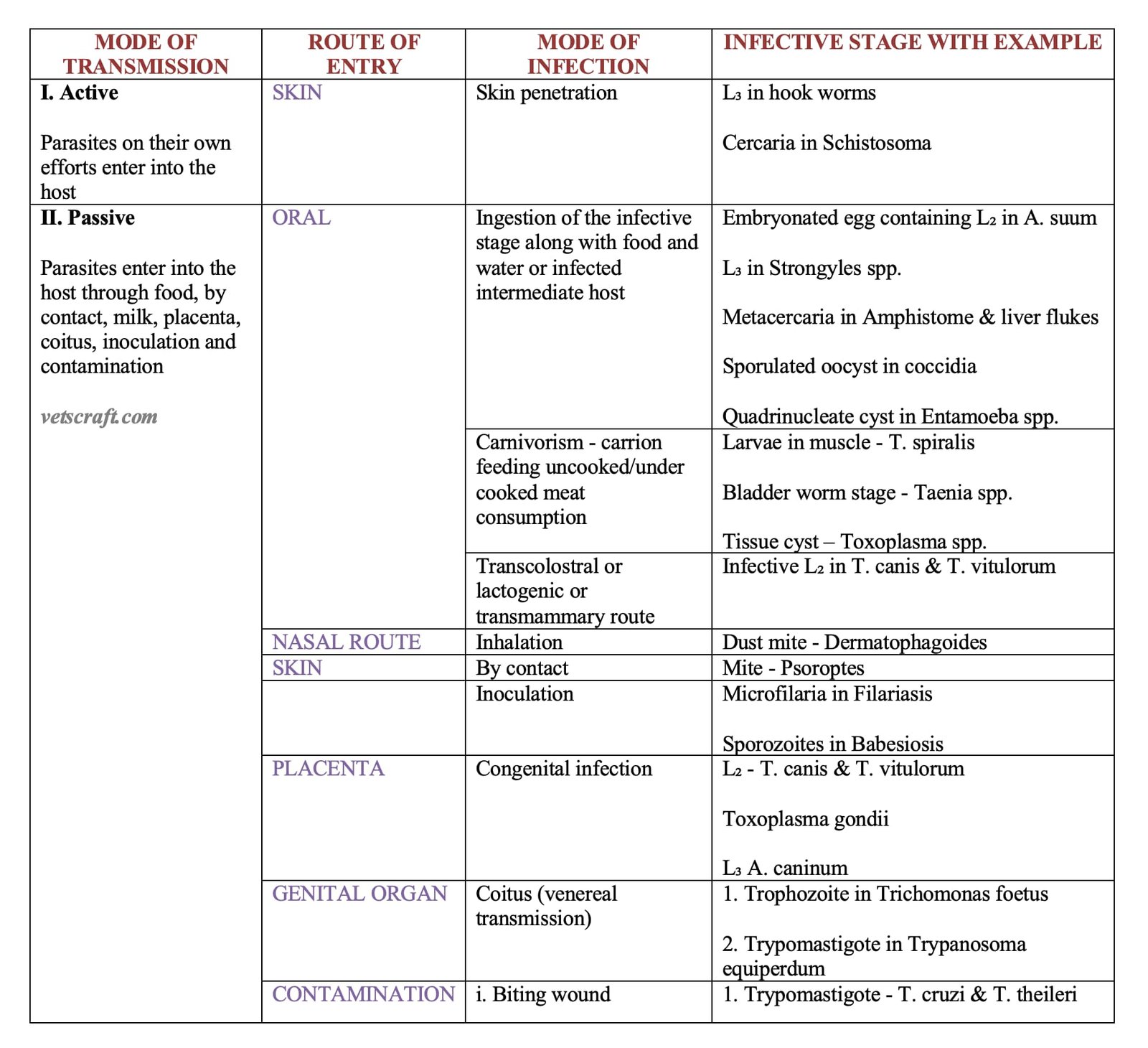
1. Active Transmission
In active transmission, parasites enter the host by their own efforts, usually through skin penetration.
- Route of entry: Skin
- Mode of infection: Skin penetration
- Examples:
- L3 larvae in hookworms
- Cercaria of Schistosoma
2. Passive Transmission
In passive transmission, parasites enter the host through external factors such as food, water, contact, milk, placenta, inoculation, coitus, or contamination.
A. Oral Route
Parasites are ingested through contaminated food, water, or infected intermediate hosts.
- Embryonated egg containing L2 in Ascaris suum
- L3 larvae in Strongyloides spp.
- Metacercaria in amphistomes and liver flukes
- Sporulated oocyst in coccidia
- Quadrinucleate cyst in Entamoeba spp.
Transmission may also occur through carnivorism, carrion feeding, or consumption of uncooked or undercooked meat.
- Larvae in muscle – Trichinella spiralis
- Bladder worm stage – Taenia spp.
- Tissue cyst – Toxoplasma spp.
B. Transcolostral or Transmammary Route
Some parasites are transmitted through milk or colostrum from mother to offspring.
- Infective L2 in Toxocara canis
- Infective L2 in Toxocara vitulorum
C. Nasal Route
Infection occurs through inhalation.
- Dust mite – Dermatophagoides
D. Skin Transmission
Parasites may spread through direct contact or inoculation.
- By contact: Psoroptes
- By inoculation:
- Microfilaria in filariasis
- Sporozoites in babesiosis
E. Placental Transmission
Some parasites are transmitted from the mother to the fetus through the placenta, resulting in congenital infection.
- L2 larvae of Toxocara canis
- L2 larvae of Toxocara vitulorum
- Toxoplasma gondii
- L3 larvae of Ancylostoma caninum
F. Genital Route
Transmission occurs during coitus or venereal contact.
- Trophozoite in Tritrichomonas foetus
- Trypomastigote in Trypanosoma equiperdum
G. Contamination Route
Parasites may enter the host through contaminated biting wounds.
- Trypomastigote of Trypanosoma cruzi
- Theileria
Conclusion
Parasites use multiple transmission strategies to survive and spread between hosts. Understanding these routes of transmission is important for the diagnosis, prevention, and control of parasitic diseases in veterinary parasitology.