
Salivary glands of different animals
Veterinary AnatomyParotid salivary gland is of serous type, while the mandibular, sublingual and zygomatic salivary glands are of the mixed type in salivary glands of animals.
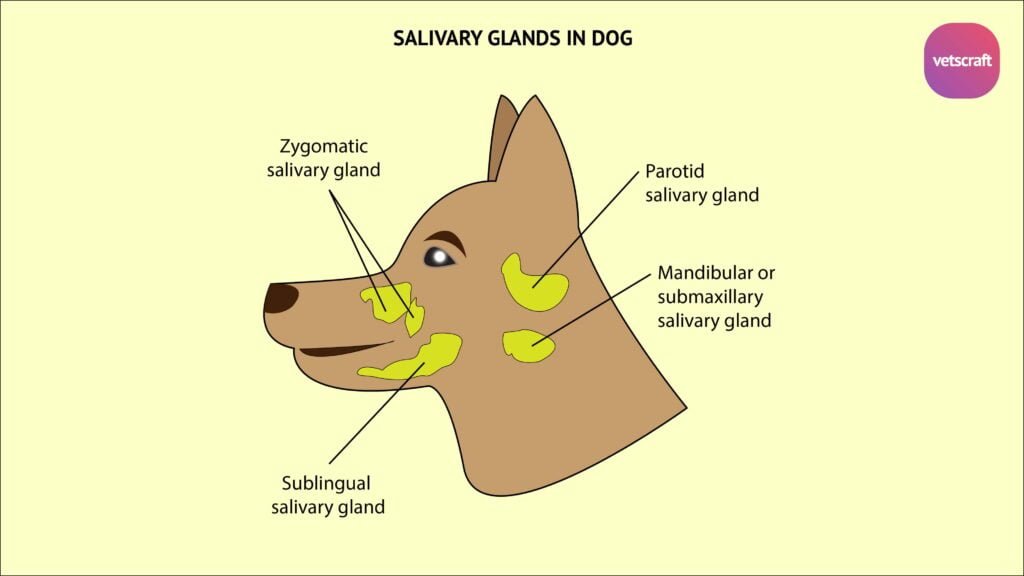
Parotid salivary gland is of serous type, while the mandibular, sublingual and zygomatic salivary glands are of the mixed type in salivary glands of animals.

The teeth of different animals are hard, white or yellowish-white structures implanted in the alveoli of the jaws. They are organs of prehension, mastication, and sometimes of defense.
Tongue of Ox Tongue (Lingua) is situated on the floor of the mouth, between the rami of the mandible. It is highly protractile and is the chief organ of prehension. It consists of a root, a body and the tip. The root is the caudal part and it is attached to the hyoid bone, soft palate and pharynx. Only
The isthmus faucium in animals is the orifice of the communication between the mouth and pharynx. It is bounded above by the soft palate, below by the root of the tongue and laterally by the cranial pillars of the soft palate It is circular, wide and very dilatable.
Floor of the Mouth of Animals Floor of the Mouth of Animals like ox, Sheep and Goat, Horse, Pig, Dog and Rabbit in this post. Floor of the Mouth of Ox The floor of the mouth of ox is free only in its cranial part and is formed by the body of the mandible covered by mucous
Soft palate (Palatum molle) of Animals Soft Palate of Ox Soft palate (Palatum molle) is a musculo-membranous partition, which separates the mouth from that of the pharynx except during deglutition. It slopes obliquely downward and backward from the hard palate. Soft palate presents two surfaces and two borders. The oral or cranial surface faces downwards and forward
Hard palate of Ox The hard palate forms the roof of the cavum oris (Buccal Cavity) in Ox. It is bounded in front by the dental pad on the sides by the alveolar arches and continuous behind with the soft palate. IHard palate is attached above to the bony palate formed by the palatine processes
Gums of Ox gums of Ox are composed of dense fibrous tissue intimately blended with the periosteum of the alveolar processes and surround the neck of the teeth. Gums are reflected with alveoli and become continuous with the alveolar periosteum and covered with mucous membrane destitute of glands and of a low degree of sensibility.
Cheeks of Ox Cheeks form the lateral wall of the mouth cavity and are continuous with the lips in front. they are attached to the alveolar borders of the maxilla and premaxilla above and mandible below. The cheeks consist- Skin Muscular and glandular layer Mucous membrane The skin of the face continuous over the cheek
Lips of Ox The lips are two in number in case of ox- upper and lower. these are thick, wide and comparatively immobile musculo- membranous folds, which surround the rima oris. The angles of union of the lips- the commissures are situated 5cm behind the level of the corner incisor tooth. Each lip presents two surfaces