Pineal gland physiology

Veterinary Physiology

Pineal gland physiology Pineal gland is the main translator of photoperiodic effect in animals. The pineal gland produces a hormone, melatonin in response to darkness. Light passes from the retina to supra chiasmatic nucleus of the hypothalamus, superior cervical ganglia and to pineal gland. The melatonin inhibits gonadal activity. Cat and horse are positively affected with

Pineal gland physiology Read More »

Amygdala

Veterinary Physiology

Amygdala Amygdala morphologically forms the part of the basal ganglia and has bi-directional connections with hypothalamus.  Amygdala receives input signals from all the portions of the limbic cortex, the orbital surface of the frontal lobe, cingulate gyrus, hippocampal gyrus, neocortex of the temporal, parietal and occipital lobes especially from the auditory  olfactory and visual associated

Amygdala Read More »

Functions of limbic system

Veterinary Physiology

Functions of limbic system Limbic System Limbic system consists of cortical and subcortical areas which are structurally and functionally related to forebrain. It forms a ring of forebrain structures that surround the brainstem and are interconnected by intricate neural pathways. The components of the limbic system are hippocampus, amygdala and cingulate gyrus. It is concerned

Functions of limbic system Read More »

Basal ganglia

Veterinary Physiology

Basal ganglia Basal ganglia is situated deep within the cerebral hemisphere as sub cortical gray matter with large masses of nerve cells. This acts as a part of the motor cortex in birds in which the motor cortex is poorly developed.  It has corpus striatum (striated body), globus pallidus (pallidum) and the amygdala.  It receives fibres

Basal ganglia Read More »

Central Nervous System or CNS

Veterinary Physiology

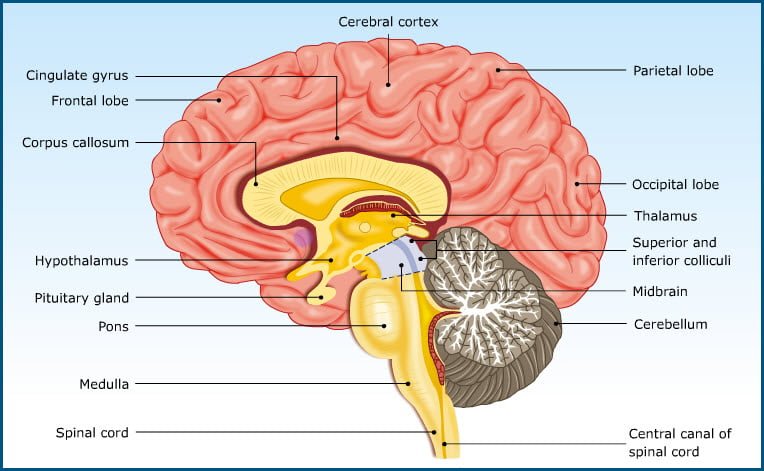
Central Nervous System or CNS Central Nervous System or CNS comprise the brain and the spinal cord. Brain consists of structures situated intra cranially and includes cerebrum, mid brain, pons, medulla, and cerebellum. Brain is divided into distinct regions, The fore brain(prosencephalon) which is subdivide into telencephalon [two cerebral  hemisphere] and diencephalon or inter brain

Central Nervous System or CNS Read More »

Scroll to Top